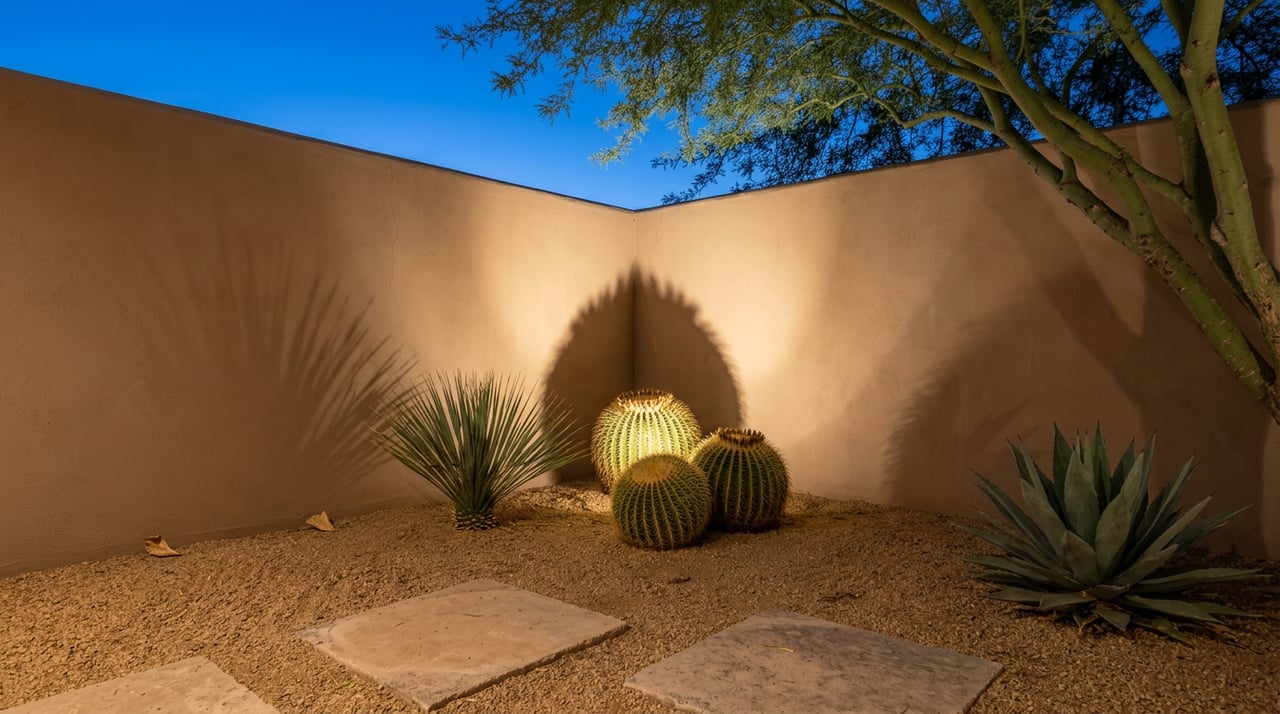
The Desert Botanical Garden Gave Every Weeknight Its Own Reason to Show Up
September 10, 2026
September 10, 2026
Ask anyone who's lived near Papago Park for a few seasons what fall at the Desert Botanical Garden looks like, and you'll get the same answer: an exhibit opens, you go see it once, maybe twice if the lights are good, and then you don't think about the Garden again until spring bloom season. That's been the pattern for years, through Chihuly's glass, through Bruce Munro's fields of light, through whatever the headline installation happened to be that year.
This fall breaks that pattern, and not because the art is better. It's because the Garden stopped treating the season as one event and started treating it as seven days a week, each with its own assignment.
The headline is Super Bloom by Graphic Rewilding, an immersive installation spanning 21 locations across the Garden. During the day it reads as oversized botanical illustration, giant desert flowers and pollinators rendered at a scale that turns a regular stroll into something closer to walking through a picture book. After dark, the same installations shift into a lit, colored version of themselves, so the exhibit is really two exhibits depending on when you show up.
That part will get covered everywhere. What won't get covered as clearly is what's happening underneath it, on the calendar itself.
Starting the week of October 9, the Garden assigned a running theme to nearly every night of the week. Not a rotating special every few weeks. A standing weekly appointment, the kind you'd put on a calendar the way you'd put down a gym class or a standing dinner.
| Night | Program | Runs through |
|---|---|---|
| Monday | Uncorked Mondays: Sips, Strolls & Sounds | Oct. 12–Nov. 23 |
| Tuesday | Tacos & Tequila in the Garden | Oct. 13–Nov. 24 |
| Wednesday | Dogs in the Garden: Nights | Oct. 14–Nov. 18 |
| Thursday | Sunset Socials: Create, Play & Dance | Oct. 15–Nov. 19 |
| Friday | Music in the Garden | Oct. 9, 16, 30, Nov. 6, 13, 20 |
| Saturday | Dogs in the Garden: Days | Oct. 10–Nov. 21 |
Look at that table and count what's missing. Sunday. Every other night of the week now has a name and a reason attached to it, and Sunday is the one day left alone, presumably for people who just want to walk the trails without a theme attached. That's a real choice, and it tells you something about who this calendar was built for: not the tourist checking a box on a Phoenix visit, but the person who lives fifteen minutes away and might come three times in six weeks instead of once.
Garden President and CEO Chris Kline framed the season as more than the headline exhibit, calling it the start of what he described as an extraordinary fall stretch for the Garden. That's the kind of quote that sounds like boilerplate until you look at what's actually on the calendar and realize the claim holds up.
The weeknight programming doesn't replace the bigger seasonal events. It sits underneath them. Layered on top of the standing Monday-through-Saturday slate is a run of named, dated festival weekends that give the season its punctuation marks:
Kids' programming runs alongside all of it too, with Cactus Clubhouse through Oct. 10 to Dec. 3 and Storytime sessions scattered across late October and November. So a family with small kids and a couple without them are both getting a reason to treat the Garden as a weekly habit rather than a once-a-season outing, just on different tracks.
Desert Botanical Garden has spent more than two decades building a reputation as one of the country's more serious venues for art set against desert landscape, with past collaborations from Dale Chihuly, Bruce Munro, Philip Haas, Rotraut, and HYBYCOZO. The most recent of those, Framerate: Desert Pulse, ran through May 10, 2026, and was built from a two-year LiDAR scanning project across roughly 20 locations both inside the Garden and out in the Valley, a collaboration with the UK-based studio ScanLAB Projects.
That history matters here because it tells you Super Bloom isn't a departure in ambition. What's different this year is the infrastructure built around it. Past headline exhibits arrived and stood on their own, drawing a single wave of visits. This time the Garden built a weekly rhythm designed to keep bringing the same person back on a Tuesday for tacos, a Thursday for a sunset social, and a Friday for live music, with the art as the constant backdrop rather than the single reason to go.
If you already live in the Phoenix area, the practical read is simple. The Garden is open early, from 6 a.m., which still matters in a place where October mornings are the last reliably cool stretch before the holidays. Tickets for Super Bloom go on sale this month, which is worth knowing now rather than in October when the festival weekends start competing for the same calendar space.
The bigger shift is in how you'd plan around it. Instead of picking one night to see Super Bloom and calling it done, the actual opportunity this fall is picking a weeknight that fits your week, Tacos & Tequila on a Tuesday or a Sunset Social on a Thursday, and treating the Garden the way you'd treat a standing reservation somewhere else in the neighborhood. The art is the same whichever night you go. The company, the food, and the pace change depending on which night you pick.
That's a small thing, but it's the kind of small thing that changes how a place actually gets used by the people who live near it, which is a different question than how it gets used by everyone else.
Papago Park sits close enough to Arcadia and the Biltmore corridor that a lot of longtime residents already treat the Garden as an extension of the neighborhood rather than a destination they drive to. This fall gives that habit an actual weekly shape for the first time in years.
If you're the kind of person who tracks these details because they shape how a place feels to live in, not because you're planning a move, that's exactly the kind of local read Sue Shapiro keeps an eye on. Reach out anytime you want a second opinion on what's actually changing in the neighborhoods she covers, this fall or whenever you're ready to talk about what's next.
Stay up to date on the latest trends in real estate.
Get assistance in determining current property value, crafting a competitive offer, writing and negotiating a contract, and much more. Contact her today.