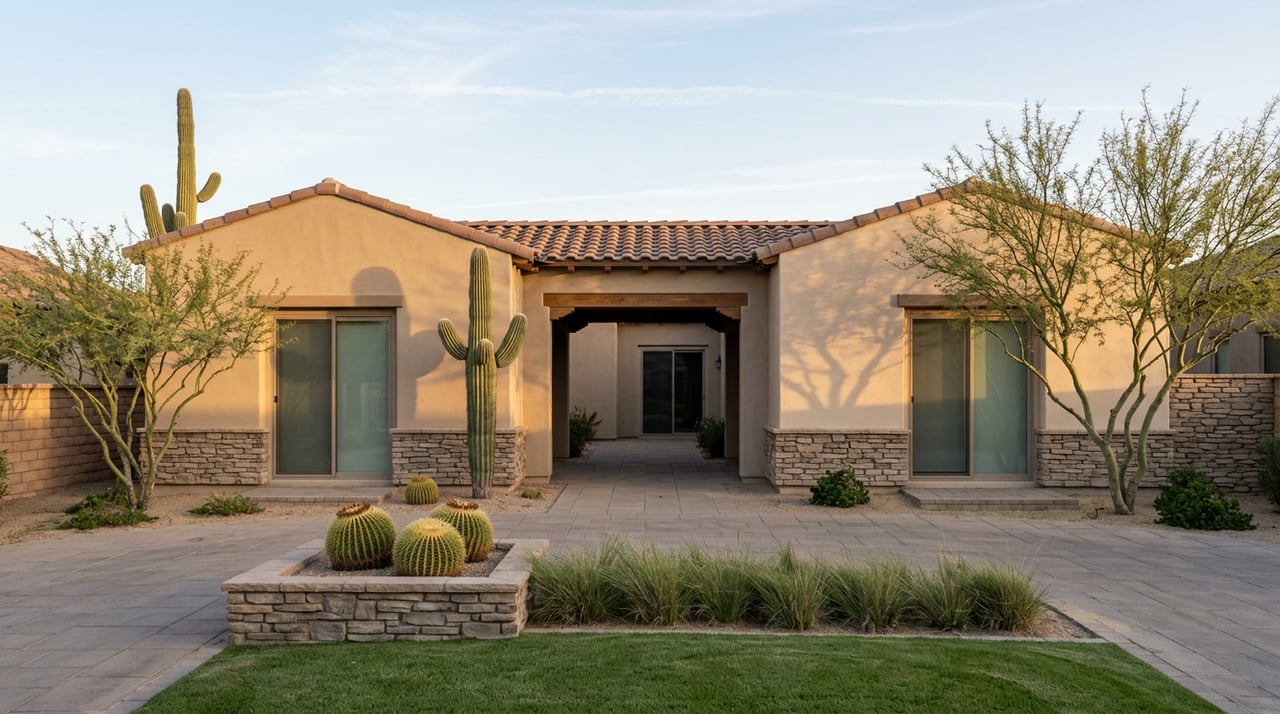
Arizona Biltmore Estates Has Two HOAs. The State Just Doubled Your Disclosure Homework.
September 24, 2026
September 24, 2026
A buyer who wrote an offer on a patio home in Two Biltmore Estates this month found something unusual waiting in the closing file: two HOA phone numbers, two management companies, and two disclosure packets to read before the inspection period closes. One request goes to AAM LLC, which manages the Two Biltmore Estates Condominium Association directly. The other goes to FirstService Residential, which manages the Arizona Biltmore Estates Village Association, the master HOA that sits above it. Eight days before this was written, a new Arizona law changed what both of those packets are required to contain, and changed when the clock on delivering them starts.
If you are buying or selling anywhere in Arizona Biltmore Estates, that timing is not a footnote. It is the thing to understand before you write or accept an offer.
Most Phoenix-area buyers think of an HOA as a single relationship: one board, one management company, one packet at closing. Arizona Biltmore Estates does not work that way. The Arizona Biltmore Estates Village Association, known locally as ABEVA, is the master association covering all residential properties and certain commercial properties in the Biltmore area. Beneath it sit 17 individual residential communities, each with its own sub-association, its own governing documents, and in most cases its own management company. ABEVA covers landscaping, streetlight and paving maintenance for the shared areas outside those individual communities, the resort entrance, and 24/7 roving patrol. The sub-association handles everything specific to your building or your streets.
That means a home in Two Biltmore Estates is technically a member of two associations at once, and each one bills, governs, and discloses separately. It is also worth knowing that ABEVA's relationship with its member communities is not identical across the board. Two of the 17, Fairway Lodge and Two Biltmore Estates, are billed by ABEVA specifically for road and streetlight maintenance rather than the full assessment structure that applies elsewhere. If you are comparing the ABEVA packet against what a neighbor in a different sub-association received, do not assume the numbers should match.
Arizona's resale disclosure statute has always required a baseline set of documents before a sale closes. House Bill 2397, signed by Governor Katie Hobbs on June 22, 2026, added several items that predict trouble rather than just describe structure. The law took effect September 12, 2026, and it amends the statutes covering both condominiums and planned communities, which means it reaches every one of the 17 sub-associations in Arizona Biltmore Estates along with ABEVA itself.
| Packet contents | Before September 12, 2026 | After September 12, 2026 |
|---|---|---|
| Governing documents | CC&Rs, bylaws, rules | Same, unchanged |
| Financials | Current budget, most recent annual financial report | Adds operating and reserve account income and expense statements |
| Board activity | Not required | Minutes from the three most recent open board meetings |
| Property-specific issues | Pending litigation summary | Adds any outstanding, unresolved violation cited against the unit |
| Association status | Not required | Declarant control status |
| Condo-specific | Not required | Whether a corporation or LLC owns and leases 35% or more of the units, insurance certificates with limits and deductibles |
| Delivery clock | Started after a separate written notice | Starts at offer acceptance |
| Fee | Capped at $400 aggregate, seller-paid in practice | Same $400 cap, but can now be billed to the buyer |
The dollar cap has not moved. What moved is the substance behind it, and who might end up paying it.
Before this law, requesting two packets in Arizona Biltmore Estates was mostly an administrative step your escrow officer handled without much drama. The documents were thin enough that reading two of them did not take much longer than reading one. That changes now. Board meeting minutes are where you learn whether the board discussed a special assessment for course maintenance, a pending roof replacement, or a dispute with a vendor before it ever shows up in a formal notice. Reserve account statements tell you whether the association is funding its future obligations or deferring them onto whoever owns the property when the bill comes due. An outstanding violation tied to the specific unit tells you about a problem the seller may not have mentioned.
Under the new law, you get that picture twice: once from your sub-association's board, and once from ABEVA's. Because ABEVA levies its own annual assessment directly on each of its more than 1,688 member homes, paid in advance every November 1 at the start of its fiscal year, it functions as a genuine second association for disclosure purposes, not a formality layered on top of the one that actually matters. Two packets now means two sets of minutes, two reserve pictures, and two $400 caps, which puts the combined disclosure cost as high as $800 before any rush fee, and that cost can now land on the buyer rather than the seller by default.
There is a separate transfer fee to watch for as well. If a sub-association's CC&Rs authorize one, it is not subject to the $400 cap and is paid at close of escrow, fully negotiable in the purchase contract. That fee is not part of the disclosure packet at all, but it shows up on the same settlement statement, and buyers who only budget for the capped disclosure fee sometimes miss it.
Not every address in the neighborhood carries this dual obligation. ABEVA's own governing information notes that certain grandfathered properties located on Biltmore Estates Drive are exempt from ABEVA's control entirely. If you are looking at one of those parcels, the two-packet question does not apply the same way. You may still be part of a sub-association's CC&Rs, but you sit outside the master association's authority, and by extension outside its disclosure obligation. It is a small detail, but it is exactly the kind of thing that only shows up when someone checks ABEVA's own literature rather than a generic HOA overview.
Does every home in Arizona Biltmore Estates need two disclosure packets? Most do, since most of the 17 sub-associations sit under ABEVA's master structure. The confirmed exception is the grandfathered group on Biltmore Estates Drive, and even there, confirm the specific arrangement with title before assuming.
Is the $400 fee cap per HOA or per transaction? It applies per association. If your property is governed by both a sub-association and ABEVA, each can charge up to $400 for its own packet, which is how the combined cost reaches $800.
What if my closing lands right around September 12, 2026? Talk to your title company directly about which packet standard applies to your specific file. Depending on when the packet was generated relative to the effective date, you may need to request an updated version that includes the newly required documents.
None of this is legal advice, and the specifics of any fee, timeline, or exemption should be confirmed directly with ABEVA, the relevant sub-association, and your title company before you rely on them in a live transaction. What it should tell you is that a neighborhood this layered rewards buyers and sellers who ask precise questions early, not after the inspection period is half gone.
If you are weighing a purchase or a sale in Arizona Biltmore Estates and want someone who already knows which management company to call first, Sue Shapiro has spent decades working through exactly this kind of local detail. Let's Connect.
Stay up to date on the latest trends in real estate.


Get assistance in determining current property value, crafting a competitive offer, writing and negotiating a contract, and much more. Contact her today.